The Lohe Hoard
Coin finds, loose finds, and hoard finds
Coin finds are exactly what they sound like – discoveries of coins. Coin finds can be individual (a single coin) or treasure finds (two coins or more). The Loheskatten, weighing just over 200 kilograms, is a hoard find and the largest silver hoard ever found in Sweden. It was discovered at Lilla Nygatan 5 in Gamla Stan, Stockholm. In three copper cauldrons, 80 silver objects, a gold necklace, and over 18,000 coins were found.
The Lohe family
The first members of the Lohe family to leave Germany and settle in Sweden arrived during the 1620s. The family operated a shipping business with several ships, landed estates, as well as iron and sugar mills. Because the family was wealthy, they also engaged in lending activities with high interest rates.
During the latter half of the 17th century and early 18th century, banker Johan Lohe was one of the wealthiest men in Sweden. He died in 1704, leaving his fortune to his wife Anna, which created friction among the siblings. Conflicts arose over the inheritance, and the siblings sued their mother in court. After four years of legal battles within the family, Anna eventually relented, and the family divided the fortune while the siblings took over the management of the family business. After Anna's death, new conflicts over the inheritance arose, lasting for six years. The siblings formed alliances, and after a lengthy legal process, a conclusion was reached.
It was Anna who purchased the residence at Lilla Nygatan in 1722. Together, Johan and Anna Lohe had 18 children, 13 of whom reached adulthood. In the house at Lilla Nygatan 5, Anna Lohe lived with two of the couple's children, Adolphe Tobias and Johanna Lohe. The siblings remained unmarried and lived in the residence after Anna's passing, staying there until both died in 1759.

Produced by: UR Samtiden
Discovery of the coin hoard
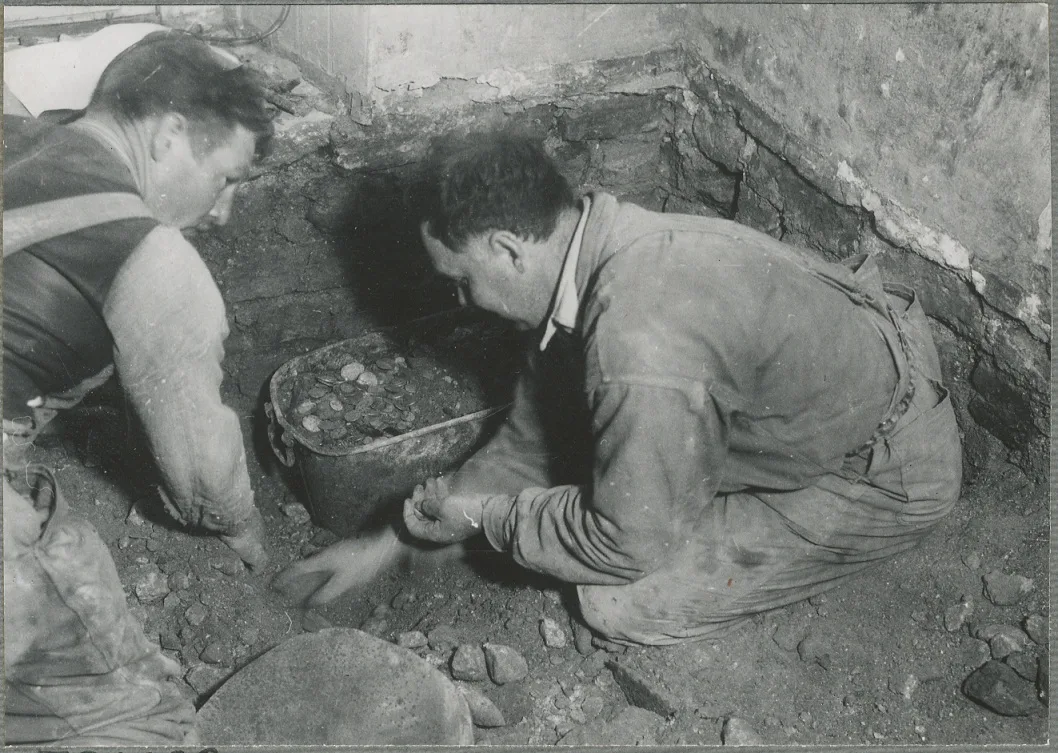
On October 15, 1937, the hoard was found at Lilla Nygatan 5 in Stockholm. At the time, the premises were a potato shop, and work had been ordered to remove the cellar.
One of the construction workers, Karl Westerberg, discovered the hoard when he thrust a shovel into the ground. When they began to understand what they had found, work ceased. The Swedish National Heritage Board was contacted, and two archaeologists were sent to examine the find.
What was found among the hoard?
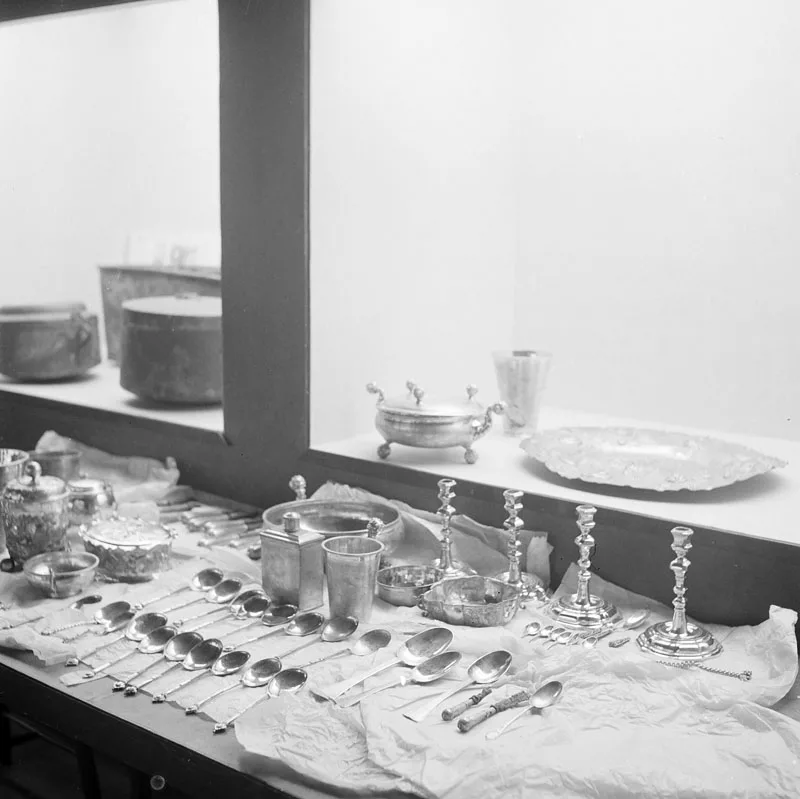
The entire hoard consisted of around 18,217 coins, three copper vessels, 80 silver objects, and a gold necklace. In total, the hoard weighed over 200 kilograms. Among the silver items were bowls, plates, teapots, and candlesticks.
The Lohe Hoard is indicative of the family's wealth. Six silver candlesticks are included, four larger ones and two smaller ones. The four larger candlesticks are identical, with the exception that two have the inscription AL and the other two have IL. The inscription may represent the initials of the siblings, Adolphe Tobias Lohe and Johanna Lohe. Historically, Johanna has sometimes been written with an I instead of a J.
Among the bowls, there is a candy dish, a cold dish, and bowls for various other uses. The candy dish is engraved with the letters HL, which could be the initials of Johan Lohe's uncle, Henrik Lohe.
Among the items in the Lohe Hoard, there are also table and eating utensils. Twenty spoons, six teaspoons, handles for eleven knives, and eleven forks. The spoons, made of gilded silver, are funeral spoons. During the 18th century, in aristocratic families, funeral spoons could be distributed to those who performed a certain service during the funeral, such as pallbearers, clergy, or priests. These spoons often bore the name of the deceased, birth and death dates, and served as tokens of honor. The spoons in the Lohe Hoard are inscribed with the words "JOHAN LOHE obiit d. 19 JANV 1704."
A symbol of wealth?
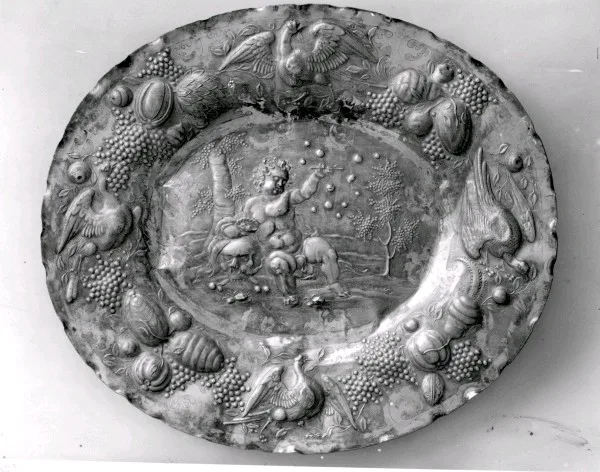
A magnificent item in the Lohe Hoard is a Baroque-style presentation tray found above one of the three bronze cauldrons. A presentation tray is a decorative item that could be displayed during fine dinners along with other ostentatious items. They were meant to symbolize wealth. This tray was crafted by the goldsmith Henning Petri. The motif is one of his more common designs, featuring a cherub blowing soap bubbles. The oval-shaped tray is the largest presentation tray from Petri's workshop, measuring 500 millimeters in diameter.
The discovery of the Lohe Hoard also included a silver teapot, found in one of the copper cauldrons. This teapot is unusually large, which may suggest that its function was not to serve hot drinks but rather to store money. When the teapot was discovered, it contained 912 coins.
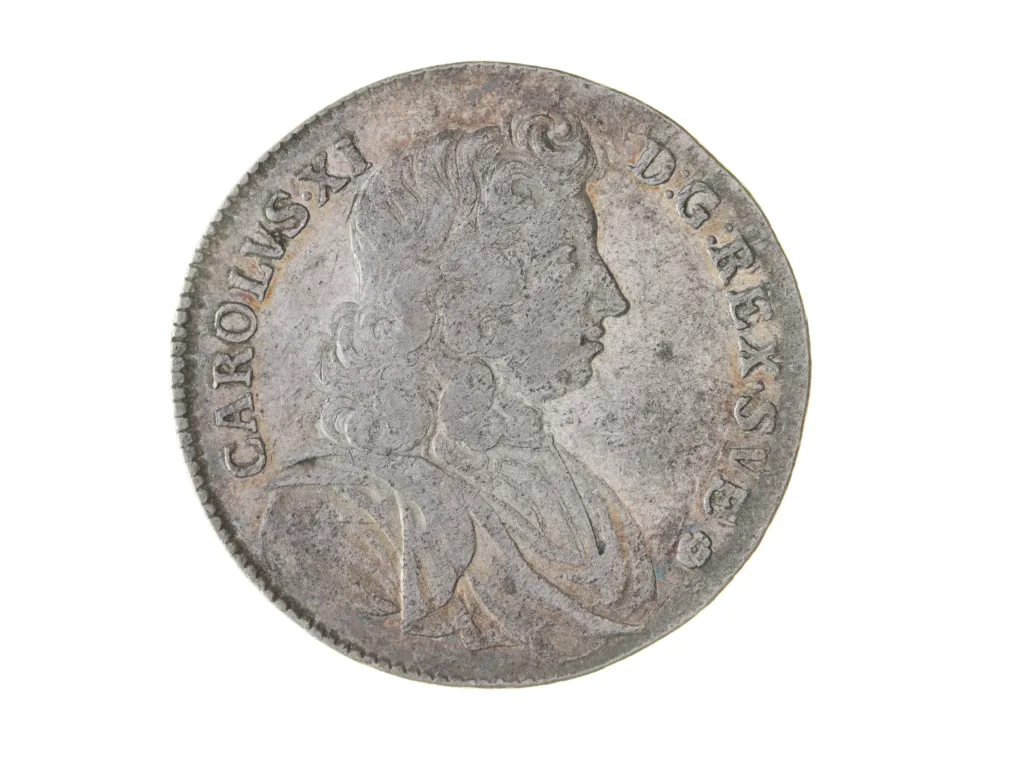
One interesting aspect of the Lohe Hoard is that it contains denominations with high values. Most of them are Swedish coins, except for 15 different coins. These coins date from the period when Queen Christina ruled Sweden to King Frederick I. Many of the coins found are mark coins, approximately 15,000 in total. The denominations are 1 mark, 2 marks, 4 marks, and 8 marks. The next most common denomination is 10 swedish öre.
What happened to the hoard?
At present, it's impossible to determine when the hoard was buried, why the items were buried, or if it was indeed the Lohe family themselves who chose to hide the items. However, we know for certain that the hoard belonged to the Lohe family because several family members' initials are engraved on many of the items. The silver items found in the Lohe Hoard are also listed in the probate inventory from 1731. It is estimated that the hoard could have been buried as early as 1741, as the youngest coin is from that year.
A public success
When the hoard was discovered, it caused a great sensation. Just ten days after its discovery, it was exhibited at the Stockholm City Museum. It remained there for three weeks and became a public success. During these three weeks, over 35,000 people came to see the items from the hoard. Afterward, the hoard was sent on a traveling exhibition to more cities.
Karl Westerberg and the other four construction workers received a reward for discovering the Lohe Hoard. They were given 15,000 kronor to share, which was considered a substantial sum in the 1930s.
Today, the coins and medals from the Lohe Hoard are kept at the Museum of Economic History, while the other items belong to the Historical Museum. These museums are part of the National Historical Museums.
